A Day With Ina May Gaskin
 I got to spend a whole day with Ina May Gaskin, well known midwife and author of books Ina May’s Guide to Childbirth and Spiritual Midwifery. She came to Pittsburgh to speak to a group of doulas, childbirth educators, midwives, labor nurses, and anyone interested in the power of birth. She gave several talks: Hands: Our Treasured Tools, Sphincter Law, Forgotten Powers of the Vagina, Demand Cesareans, and Post-Date Inductions.
I was very interested in her talk on post-date inductions because this issue is one that is so common and one that many women have to face, either by doctors who are pushing inductions for various reasons (many unnecessary), or by women who do go past their due dates. I rather enjoyed her talk on Sphincter Law. Not only was it entertaining, but she highlighted the idea that bringing humor into the labor room can be freeing for the woman in labor and can also help her labor to chug along and be less painful.
A word about induction: Did you know that first time moms who get induced are twice as likely to end up with a cesarean than mothers who go into spontaneous labor? Did you know that there are many natural things you can try to get labor going instead of opting for pitocin first? Did you know that many practices like to induce women with a drug called Cytotec (misoprostal) that has not been proven to be safe for pregnant mothers? It is a great drug to use for post-partum hemorhage but when used to induce labor, there can be many complications. Cytotec is a drug that cannot be counteracted, it can’t be turned off like pitocin can. It can’t be removed from the body. One of the complications of the drug is that it can cause hyperstimulation of the uterus which can then distress the baby. Using a drug that can’t be counteracted and can have harmful effect on both the mother and the baby is not wise. Many women are not shared the possible risks when given this drug. Ina May is very passionate about women knowing their options when it comes to birth.
In her book, Ina May’s Guide to Childbirth, she goes over the theory of Sphincter Law thoroughly. It was fun to hear her talk about it in person. The basic premise behind Sphincter Law is that the cervix also functions like a sphincter. Like our other well known sphincters (think toilet humor), the cervix doesn’t respond well to commands, pressure, or fear. How many of you have had “stage fright” when it comes to pooping or peeing in front of someone or sitting next to someone in the next stall? Our emotional state of relaxation can have a powerful effect on the cervix. Fear and shame can keep the cervix closed. Ina May talked extensively about how bringing in a sense of humor into the place of birth can help the body release endorphins that overrule the adrenaline that gets released when afraid. Sometimes not understanding what is going on with your body while it is laboring can cause fear too. Her suggestions for keeping that cervix open and able to open is to bring in humor and allowing your mouth and jaw to relax. Making low groaning sounds or making your lips vibrate like a horse can keep that jaw relaxed. (Relaxing your jaw also helps you to poop when it feels difficult to do so :).) She recommends that kissing your husband while laboring can also help keep that jaw relaxed. Of course, if you are laboring in the hospital, you might want to ask for some privacy ;).
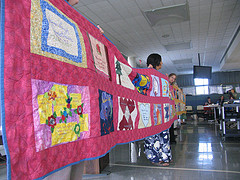 Ina May also talked about her project, The Safe Motherhood Quilt Project. She started this project several years ago to try and waken the government to the need to decrease the maternal mortality rate here in the US. Did you know that the maternal mortality rate has not decreased since 1982? It is increasing, in fact. It is also thought to be grossly underestimated. We are ranked behind 40 other countried for maternal mortality. You would think that with all of our technology that the rate would be decreasing but that is not the case. As the rate of Cesareans has risen, so has the maternal mortality rate.

Some of the deaths that happen every year of unpreventable, but many are not. Ina May started making a quilt in honor of the mothers that have died from complications of birth. An interesting phenomenon is the increase of death from amniotic fluid embolism. Some speculate that the increase of inductions is also increasing the number of deaths from amniotic fluid embolism. There needs to be more studies done so to show why there is such an increase.
I cannot tell you how important it is to spread the word for women to know their options when it comes to birth. I advocate giving birth where you feel the most comfortable. For some women, that is at home. For others, it is at a birth center or hospital. It is so important to know the procedures that are done and what the risks and benefits are. For example, when a woman show up in labor at the hospital, the staff will break her water, insert an internal fetal monitor, and even start her on a pitocin drip to speed up the labor. A mom may not know that as long as her and the baby are okay, breaking the bag of waters and inserting an internal fetal monitor is going overboard. Using pitocin when it is not needed is simply unnecssary and introduces risks to the mother and baby. She may not know that it is okay to refuse those things.
There are many resources available to help women make informed choices about childbirth. Some of my favorite books are:
- Ina May’s Guide to Childbirth by Ina May Gaskin
- The Thinking Woman’s Guide to a Better Birth by Henci Goer
- Creating Your Birth Plan: The Definitive Guide to a Safe and Empowering Birth by Marsden Wagner
- Born in the USA: How a Broken Maternity System Must Be Fixed to Put Women and Children First by Marsden Wagner
- Pushed: The Painful Truth About Childbirth and Modern Maternity Care by Jennifer Block
- Birth: The Surprising History of How We Are Born by Tina Cassidy
- Natural Birth the Bradley Way by Susan McCutcheon
Share the fun: Email + Del.icio.us + Digg + Technorati


 Ewan (the oldest) got his first ice cream when he was 2. 2! Can you believe that? I thought for sure that if a morsel of sugar passed his lips any earlier he’d turn into a sugar loving crazed kid. I know now that all kids will be lovers of sugar. Doesn’t matter what age you introduce it to them. I don’t remember how old Isaac (middle child) was when he got his first cookie or ice cream but he was a lot younger. When we thought Ewan was old enough to start chewing gum then it was hard to keep it from Isaac too. I try to tell myself that their 14 month age difference has a lot to do with it but I think I like to rationalize.
 Well, apparently the age for gum chewing with the third child is 18 months. Okay, well maybe our third child found some gum in my purse, knew what it was, unpeeled it, knew to put it in his mouth and chew. I didn’t give it to him. But I didn’t freak out after he put it in his mouth either (which I would have after child #1 or 2). I waited to see what would happen. I figured he would swallow it. Or spit it out somewhere. Speaking of which, I should probably go see if I can find that chewed treasure somewhere. But he figured out how to chew it and swallow the juices that come from a yummy piece of gum. He chewed it longer than Ewan or Isaac did when they were first getting the hang of gum.
 In truth, since I am a slightly seasoned parent, some of my parenting views and philosophies have changed too so that makes a difference in some of my decision making. I know someday I’ll hear the words from Ewan, “But MOM, you NEVER used to let me do _______!” And I’ll respond, “Wait till you have kids…”
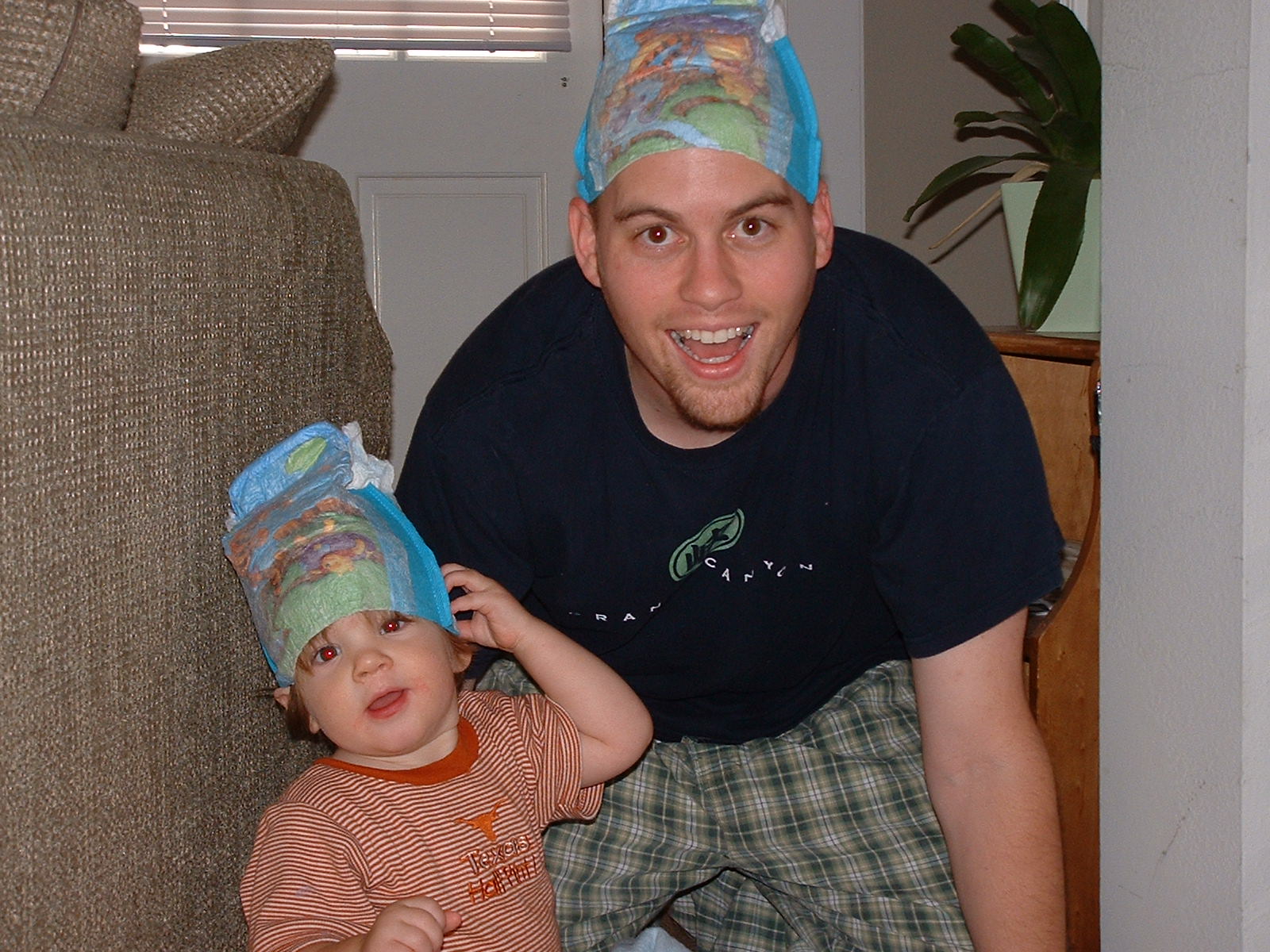 In Chapter 15 Blackmer talks about the importance of letting Dads be Dads without interfering. If you are the primary caretaker of your children then you know the ins and outs of all the daily things in life (he likes mustard, NOT mayonaise…she takes a nap with the puppy but sleeps with the bear at bedtime…he’s been scared of Barney for weeks, why did you let him watch THAT?!…she naps at 12:30 not 1…) and when we leave our children with their daddies sometimes we have a tendency to communicate that they don’t know how to take care of their own children. It is true, sometimes they don’t but when we criticize and don’t let them doing things differently without freaking out can you blame them when they give up trying? Or get upset with us for telling them they are doing it wrong and then don’t give them a chance to figure it out themselves? This is not as hard for me as it used to be but I still struggle with it somtimes. She points out that every father and son need a chance to develop their own relationship (I know it is true for girls too but this post is about boys) and sometimes, as hard as it can be, we need to step aside and let them figure it out.